


The media is full of stories on how non-life insurers, especially the PSU behemoths, are avoiding taking new consumers in health insurance as the health insurance business is reportedly not profitable. On the other hand, we see widespread campaigns by life insurers, including LIC, advertising the benefits of their newly launched health insurance plans. These new health insurance plans advertised so widely by life insurers have brought much needed public attention to this vital insurance segment.
As a consumer, you could be forgiven for being confused. Allow us to throw some light on this and clear this confusion.
The first aspect you need to understand is that the term 'Health Insurance' is a catch-all term that covers three distinct kinds of health policies.
There is the health policy that reimburses you the actual hospitalization cost for treatment of any disease, offered only by non-life insurers. These kinds of policies are popularly called "Mediclaim" policies (Mediclaim is actually a brand name but has now become a generic term for such policies).
Then there are two other types of health insurance plans offered - by both life insurers and non-life insurers.
One can loosely be referred to as a "Hospitalization Policy," where you primarily get a daily allowance for every day spent in the hospital. Some policies also provide higher daily allowance for stay in intensive care (the ICU). Yet others have a provision for a lump sum payment if you undergo any of the surgical procedures covered in the policy.
The other type of health insurance cover offered by life insurers and non-life insurers are the critical illness covers. Given the increased stress and strain of modern life as well as unhealthy and sedentary lifestyles, most of us are becoming increasingly prone to serious illnesses, such as cancer, heart attacks, organ failure, strokes, etc. Advances in modern medicine ensure that most of us survive these illnesses. This survival, however, comes at a cost - a serious dent in our ability to earn (salary or from business). Critical illness cover steps in here and pays off a lump sum benefit - that helps in protecting your current lifestyle.
Most life insurers have long offered these covers as riders (Riders are covers for additional risks or to enhance existing risk covers). Now these critical illness covers are also being offered as stand-alone policies to cover the risks of specific kinds of critical illness such as say, cancer. These policies are recommended, at the very least, for income earners - contracting a critical illness has a huge financial impact on their future income.
A very relevant question at this point would be:
Do I require a hospitalization policy if I already have a Mediclaim policy?
The Mediclaim policy only reimburses the expenditure incurred in the actual treatment of the disease/illness at the hospital. There are several other expenses that are typically incurred, which the Mediclaim policy does not reimburse. Expenses such as travel, attendant's lodging, loss of income (for both the patient and/or the attendant), pre-hospitalization diagnostic tests, medicines, etc. can run up to as much as 30-40% of the total cost of treatment of a disease or illness. A hospitalization policy takes care of these expenses.
Life insurance companies have done a great job in bringing this topic of health insurance to the forefront of consumer consciousness and hopefully each one of you (unlike our earlier generation which mostly left it to God) will cover your health risks adequately.
We have put together a table that gives you an easy comparison of the various features in each type of policy, and the relative advantages and disadvantages of life insurers and non-life insurers offering these products.
As you will find, the policies offered by life insurers are actually in addition to, not replacing Mediclaim policies.
Remember, it is an absolute must that you and your dependents have adequate cover on your Mediclaim policy. It cannot be replaced by any other kind of policy.
Tuesday, October 21, 2008
Health Insurance Plans - Life Insurers vs. Non-Life Insurers

Importance of PI Insurance for Photographers
When you are setting up your photography business, you should ensure adequate protection for your business by insuring your profession against any likely risks with Photographers insurance. By opting for a PI Insurance you can cover all your legal and fiscal liabilities. A small expense on Professional indemnity or PI insurance will provide you immense peace of mind and will insure your liabilities, errors and omissions.
In your routine photography business also you require photographers’ insurance coverage against claims made against occurrence of accidences during a photographic session. You are liable for the personal injury sustained by your customer on the way to your studio or home. You become indirectly responsible for the errors not committed by you.
As a professional photographer you may commit errors and omissions from the first stage of taking photographs to the last stage of finishing the image and delivery to the customer. You may lose the film due to your fault or on the part of the processor. The photo images may also be lost or damage while in transit, shipping, private careers or postal system. The images may be lost in the cyberspace or you may send the photo images to an incorrect party.
You need a PI insurance cover according to the type of work environment and your models. It may happen that your model may be struck by a stray horse or lightning at an outside location during a photography session. The insurance policy should ideally cover the photography equipment in the place of your working area. With the photographers insurance you can protect not only camera and lenses, but a host of other equipments such as fax machine, computer and your software.
Photographers insurance or PI insurance has a unique target market with great potential for growth. Special insurance policies are designed especially to meet the needs of commercial photographers. The PI insurance coverage is essential for every photography business to meet the risks of coverage for photography equipment, cost coverage for replacement of studio contents. To get the best value for your hard earned money you can also combine the PI insurance with other types of insurance. Photography insurance keeps your photography business well and alive should a misfortune happen and cause loss or damage to your equipment, whether at your studio or round the world.
Thursday, September 25, 2008
Americans fear for their life insurance after financial turmoil
| Americans fear for their life insurance after financial turmoil |
Americans who have ploughed their savings into life insurance and annuity-linked pension funds were running scared yesterday as financial titans collapsed around them.
"We're receiving phone calls that we wouldn't usually get," said Robert Willis, Executive Director of DC Life and Health Insurance Association, part of the national network that guarantees insurance policies.
"Given what's happening with AIG and Lehman Brothers, people are looking at their life insurance and annuity products and are concerned about these companies going under and what the impact would be on them," he said.
Wall Street icon Lehman Brothers filed for bankruptcy in New York on Monday after suffering massive losses from the subprime crisis of loans to high-risk customers.
The following day, the US Federal Reserve stepped in with a $85-billion bail-out of American International Group (AIG) after the insurance giant also fell victim to the mortgage subprime lending meltdown.
In a statement issued Tuesday, AIG assured its life insurance clients that their policies were not at risk.
Willis tried to reassure them, too, by explaining how warranties such as those provided by DC Life and Health work. Most of the guarantees allow the investor to recover his or her initial investment plus any earnings, up to a ceiling of $300,000 in death benefits.
But the ceiling is only applicable once per person. Someone with three separate pension plans, each worth $200,000, for instance, is protected only to the tune of $300,000, said Willis.
Monday, September 22, 2008
Insurance firms to up micro sector presence

Insurance companies across the board are exploring options to branch out into rural areas and enhance their presence in the micro-insurance sector in the country.
Among the major players, LIC, ICICI Lombard, Agriculture Insurance Corporation, IFFCO-Tokio and Tata AIG are seeking ways to consolidate their presence in the sector. Also, MaxLife has launched Max Vijay to tap the micro-insurance potential.
Incidentally, the Indian insurance industry is expected to witness a 500% growth and reach $60 billion in next four years. Insurance firms are keen to exploit this potential; in keeping, ING is planning its entry in India.
The fact that these companies are focusing on micro insurance is crucial as traditionally insurance has never really expanded beyond urban geographies. This has been attributed to poor insurance literacy and awareness, high transaction costs, inadequate regulations, and inadequate understanding of client needs and expectations. According to the Centre for Insurance and Risk Management (CIRM)--which operates under IFMR Foundation-- the Centre and Insurance Regulatory & Development Authority (Irda) need make administrative and regulatory changes to enable penetration of micro insurance, especially in rural areas.
However, Rupalee Ruchismita, coordinator of CIRM, told FE, “The perception that entering rural markets is expensive has been replaced by the possibility of making rural insurance not only commercially viable and sustainable but also profitable. This is provided questions about product design and models of delivering risk hedging products are innovatively addressed.”
She admitted that India is the only country with micro insurance regulation. However, she noted that IRDA should allow more players in the sector. Ruchismita was speaking on the sidelines of a seminar on “Indian Microinsurance: What Works?” organised by Microfinance Insights, IFMR Foundation and CIRM.
She said that while the Micro Insurance Act stipulates an upfront payment of premium for micro insurance policies, people in rural areas have low incomes and are incapable of paying a lumpsum amount upfront. Therefore, allowing them to pay the premium in monthly installments will help in stimulating demand for insurance products, she added.
Ruchismita urged the centre to take administrative measures for promotion of micro insurance. She said that data must be made available to insurance companies so that they can expand their activities in rural areas.
Travel insurance: The good, the bad and the ugly

On a family holiday in Switzerland in May, a father's worst nightmare came true.
On a Friday afternoon my son had acute pain in his abdomen, the general practitioner whom we consulted advised us to rush to a hospital. At the hospital he was advised to undergo an emergency appendicitis removal operation. We were apprehensive as we were in a strange country and even communication with some of the doctors was a little challenging as some of them could not speak English fluently. In the late evening after considering the risks of not operating we gave our consent for the operation.
We could afford to pay for the operation on our own but at the back of my mind was a question whether the insurance company (my travel insurance policy was taken from a public sector insurance company) would actually pay up. The policy was part of a package taken through the tour operator who had made the travel arrangements for us. He in turn had used the services of an insurance broker to buy the package policy.
Here is my experience described in greater detail:
Friday, May 23: My son got operated at around 10 pm. He was admitted and operated without us having to fill in an admission form or making any deposit. They did not even know whether we had insurance to cover the costs.
Late at night I sent an email to the international TPA, the Indian TPA and the Indian insurance broker informing them of our impending claim.
Saturday, May 24: My son was fine and so started to try and call for activating the claim process. The initial call to the Paris toll-free number was not very fruitful with the male consultant on the other end of the line not giving any satisfactory response. But when I checked my email I had received a response from them indicating a file number for my claim and laying down the documents needed to process the claim.
I also reached a very helpful gentleman called Prakash who was the claims executive with the insurance broker in India. He made several calls to me and also spoke to the TPA in Paris and generally guided me. The hospital was also helpful and provided the necessary facility for faxing the papers to the Paris TPA. However a confirmation from the TPA to the hospital got stuck because they wanted a medical report from the hospital before providing a coverage confirmation (which would have enabled me to avail of cashless facility from the hospital).
The hospital informed me that this was not a usual request and it took a couple of hours before I could get the report and fax it to the Paris TPA. Meanwhile since it was a Saturday I was forced to make a deposit (around Rs. 125,000) to the hospital by using my credit card. While we received no final confirmation from the Paris TPA the Indian TPA had not responded at all.
Sunday, May 25: My son was discharged from the hospital.
The hospital said the deposit was enough to cover the bill and they would refund the balance in due course by crediting the balance to my credit card account. No final confirmations from the Paris TPA, though I must say that by then a very competent lady from the Paris TPA kept calling me to update me on what was happening. She also informed me that she had sent a confirmatory fax to the hospital (this was after the discharge) and as the hospital office was closed we could not confirm the receipt of the fax by them.
Monday, May 26: The hospital confirmed that they had received the fax confirmation from the Paris TPA and would refund the entire deposit amount to my credit card in a few days time after they actually receive the payment from the insurance company. Prakash had been in touch with me through out.
Tuesday, May 27: We return to India.
First week of June: Submitted a claim for expenses paid for the general practitioner in Switzerland, the ambulance charges, and the medicines purchased amounting to about Rs 25,000. This was submitted to the Indian TPA through Prakash.
Second week of June: Got the Switzerland hospital deposit amount refunded in my credit card account. Was shocked to discover that even though in Swiss franc terms I had received the full refund, there was a difference of around Rs. 13,000 in the rupee amount that I had paid and the rupee amount credited to my credit card account. On closer inspection it proved to be because of the huge 3.5 per cent each way commission that the credit card company charges (making it 7 per cent in all) as well as the significant differential in the buying and selling rate of the foreign exchange.
Meanwhile Prakash informed me that my other claim had been approved on June 13 and I could expect the payment cheque in 15 days time.
July 2008: No cheque despite vigorous follow up. Finally in the last week of July sent an e-mail notice to the insurance company that I would complain to the Insurance Ombudsman if I did not receive the payment.
August 4, 2008: Finally I receive the cheque by courier.
My learnings from the whole episode:
1. Never pay by credit card overseas. Only the card issuer goes laughing all the way to the bank.
2. The Indian insurance companies have specific requirements that make the process of pre-approval that much more difficult overseas as it is not in line with local practices.
3. The moment you submit claims to the Indian TPA brace yourself for delays.
4. Use the two magic words 'Insurance Ombudsman' in your letters and e-mails. That's the one thing that makes the wheels move.
5. The insurance broker is worth his weight in gold if they have people like Prakash working for them.
6. While the delays were annoying and the amount retained by the credit card company was scandalous, I don't think I will ever venture outside Indian shores without a proper travel insurance policy.
7. If you have to fall ill do so in a country like Switzerland, where even the general ward is better than the luxury suites of Indian hospitals. The nursing staff actually helped us in booking a hotel for the night and summoned a taxi for us. A level of service that I cannot even imagine in India.
Friday, September 12, 2008
Know about Insurance, Types of Insurance
 Insurance is defined as the equitable transfer of the risk of a loss, from one entity to another, in exchange for a premium. An insurer is a company selling the insurance. The insurance rate is a factor used to determine the amount, called the premium, to be charged for a certain amount of insurance coverage. Risk management, the practice of appraising and controlling risk, has evolved as a discrete field of study and practice.
Some Insurance Types
Different types of Insurance plans are offered based on your needs. Some of them are
• Life Insurance
• Health Insurance
• Dental Insurance
• Automobile insurance
• Property insurance
Life Insurance
Life insurance or life assurance is a contract between the policy owner and the insurer, where the insurer agrees to pay a sum of money upon the occurrence of the insured individual’s or individuals’ death or other event, such as terminal illness or critical illness. In return, the policy owner (or policy payer) agrees to pay a stipulated amount called a premium at regular intervals or in lump sums.
Health Insurance
The term health insurance is generally used to describe a form of insurance that pays for medical expenses. Basically, the client pays a sum of money called the Premium and in turn the Insurance firm would commit to pay a predetermined sum of money to meet the customer’s claims. Health insurance plans are offered in two categories. They are individual and group insurance policy. The individual plans covers health costs for a single person whereas the group health insurance plan covers medical coverage for the entire family.
Dental Insurance
Dental insurance covers dental costs for an individual or group. The costs include normal dental care cost as well as damage to teeth in an accident. Dental insurance protects people from financial hardship caused by unexpected dental expenses.
Automobile insurance
Auto insurance protects the policy owner against financial loss if he has an accident. It is a contract between policy owner and the insurance company. The policy owner agrees to pay the premium and the insurance company agrees to pay the losses as defined in your policy.
Property insurance
Property insurance gives protection against your property. This includes specialized forms of insurance like fire insurance, flood insurance, earthquake insurance, home insurance etc.
Travel Insurance - Smart Choices
You decide to take that once-in-a lifetime trip, the one you’ve always dreamed of and you want to make sure that nothing goes wrong. As any human being, you are aware that you do not have a total control over your life and that accidents can happen. Travel insurance is a necessary item if you are going on a vacation.
The competition on the insurance market is stringent and there are many companies ready to offer travel insurance suitable for one’s needs and preferences. Remember that is vital that you purchase travel insurance in order to protect your travel investment.
While browsing, decide what type of coverage you require. Take in consideration several factors such as: journey duration, destination and your age and health conditions. You should also check if preexisting conditions are covered by your travel insurance.
Travel insurance is a necessity you cannot do without. It offers coverage for unpredictable situations such as: cancellation of trips, delays of travel, lost of luggage and personal belongings, emergency evacuation or medical expenses. Some travel insurance policies have additional claims for accidental deaths.
For travel to Canada, it is best that you choose to purchase travel insurance for Canada as it has certain advantages. Former English colony, Canada is the world’s largest country by land mass and offers a broad range of cultural and geographical features. This outstanding country offers its visitors one of the most untamed landscapes in the world. Still, all tourists are encouraged to have travel insurance in Canada for safety reasons.
You should also check if the travel insurance you choose has additional features like: travel document loss, optional medical benefits (helicopter for emergency cases), and accidental death during flight. These things are difficult to think about but not impossible to happen. It is best to be prepared and purchase complete travel insurance. In order to arrive to an informed decision search online, compare prices and benefits. In short: canvas and compare.
The tricky part is finding the appropriate travel insurance quotes. You just log on to your computer and go online. There are many insurance companies ready to offer free travel insurance quotes on their sites. Consider the features and compare figures.
Travel insurance quotes can be easily obtained by completing a form with basic information. After filling out the form, you will receive travel insurance quotes from several companies. These travel insurance quotes show in detail different travel insurance options, deductible and other details. This will help you pick out the best plan based on your need and preferences.
Choosing a reputable website can help you obtain instant travel insurance quotes from leading companies and also personalized travel insurance assistance. These travel insurance quotes are always up-to-date and accurate not to mention that there is a wide selection online. You can look at several different travel insurance quotes at the same time online, in a short period of time.
You can find on the Internet various travel insurance quotes for Canada from leading Canadian companies. These companies are the best on the market and they have been meeting the demands of a diversified population for many years. Travel insurance quotes in Canada are easy to find but you have to be careful if they are meeting your needs.
Traveling will always offer lifetime lasting memories. So it is in your best interest to look after yourself and purchase full travel insurance in order to feel safe and have fun. There is no reason to be skeptical; purchasing travel insurance is a must.
Homeowner’s Insurance Tips Guide
As the demand for homeowner insurance is increasing day by day, numerous companies are offering the home insurance policy. Since a myriad of options are available now, an individual needs to be quite careful while purchasing a policy. There are several key points that should be borne in mind and that can actually help you purchase a good policy.
Before you start looking around for a policy, decide amongst yourself what all coverage and the coverage amount you want. Then look for various companies and their offers. In this you can take help of agents, friends and family members. Internet too is a good source for information. You can obtain various price quotes from there. While comparing rates make sure that they are for same coverage’s.
Deductibles play a crucial role in choice of a policy. Deductible is the amount a person needs to pay before the insurance company to pay for him. Higher deductibles are instrumental in lowering the premium rates. So it is better to look for high deductibles though you will have to pay if you have a claim.
Never think and try of giving fake information to acquire the insurance policy. You can land yourself in grave trouble. So be true while obtaining a price quote and applying for insurance. For wrong information can lead to denial of coverage and incorrect price quotes.
But don’t just get carried away with the price (premium rates etc.) as most people do. Other factors such as company’s financial ratings and stability, its reputation in the market, customer service record, complaint index and the like also do matter a lot. Thus make sure you check these things out.
Also see if the agent offering the policy is licensed or not. It is in your interest to purchase a policy from certified i.e. licensed companies and agents.
Usually it is very difficult for people who reside in high-risk zone and defaulters to acquire a homeowner’s insurance. High-risk zone stands for areas prone to floods, hurricanes and other natural calamities and also areas where the crime rate is quite high. In such a case you need to make an extra effort to get a homeowner’s policy. You need to speak to other people living in the zone and any previous insurers. If you propose to shift to one such place then ask you current insurance agent to help you get one such insurance.
You should also know that usually the homeowners insurance covers personal items such as jewelry, fur, watches, silverware, valuable papers and securities etc. If you seek to have coverage apart from this then you have to fill up the Personal Articles Form. Speak with your agent about the coverage that is already there and about what additions you require.
When it is time to renew your homeowner’s insurance policy, ponder again over the coverage issue. Check your personal details in the policy and see if it is up to the mark. In case you require more coverage for any expensive items you purchased such as electrical appliances etc., ask your agent to get your policy changed accordingly.
Top 5 Jobs Which Require Life Insurance
Life insurance is an important aspect of everyone’s lives and is something which everyone will have to face at some point in time throughout their lives. This point may come sooner rather than later for some individuals because of the job they perform on a daily basis.
While some individuals start everyday by putting on their suits and racing to get to the coffee shop for their morning coffee, others are strapping on their work boots and preparing themselves for a day of excruciatingly hard labor. As scary as it may sound, there are many individuals who are willing to put their lives in danger every single day when they get up and go to work.
The following is a list of the top 5 jobs which are considered to be the most dangerous jobs in the world. Individuals who perform these jobs are highly recommended to have a life insurance plan incase (god forbid) anything goes wrong on any given day. These are the 5 occupations which made the list:
1.Police/Detectives - Police Officers face life threatening situations almost everyday. They are highly trained to defend themselves and are equipped with protective equipment at all times. Life insurance and disability insurance are crucial for individuals working in the field of policing.
2. Airplane Pilots - Believe it or not, airplane pilots require life insurance because they are dealing with such powerful machines which have been known to have mechanical glitches. Airplane pilots are also highly trained in their field to make sure they do their best to fly safely.
3. Construction Workers - Construction workers are somewhat unappreciated for the amount of hard work they do everyday. They not only put their lives in danger from all the machinery they are expected to operate, but they also face many factors which will affect their health in the long run. Overexposure to sun, heat and excessive lifting are just a few of these factors.
4. Farm Workers - Much like construction workers, farm workers are at high risk of injury or death due to the fact that they are constantly operating heavy machinery. There are hundreds of farm work related deaths a years and thousands of injuries for individuals working in farm fields. Life insurance and disability insurance are important for individuals in this occupation.
5. Fire Fighters - It is a known fact that fire fighters put their lives on the line everyday to save the lives of others. Knowing the potential consequences and performing the job anyways indicates that these workers deserve the highest level of respect from others. Individuals who have chosen careers in firefighting are also likely to have a life insurance policy.
Is your job dangerous? Is your life on the line everyday? Maybe not, but there are many other factors other than your occupation which may indicate you need life insurance. Life insurance is a plan which will ensure your loved ones are taken care of incase anything happens to you. Wouldn’t you like to know your family would be looked after should this type of situation occur?
Saturday, February 16, 2008
The health insurance problem is not an insurance problem, it is a health problem
When people start talking about health insurance reform and how to bring health insurance to the American people, they inevitably end up in a ridiculous discussion about how to negotiate the cost of drugs, how to provide drug discounts to senior citizens, or how to engage in a system of managed care that denies medical services to certain groups. It's all a rather useless exercise in shifting paperwork, blame, or money from the pockets of one organization to another. And in the end, it helps no one.
Health insurance reform needs to focus on the health, not the insurance, because you can never solve a problem by shifting paperwork to another party or bu denying services to an ever-expanding group of people. It's similar to the way in which the federal government wants to solve social security: just keep raising the qualification age until it's so high that almost nobody lives that long. How's that for security? "If you live long enough, we'll even pay you back all the money you worked for!"
In the realm of health insurance, we need to start talking about disease prevention. The only way we're going to lower the costs in the long run is if we make our population healthier. And the only way we're going to make people healthier is if we start admitting the truth about the detrimental health effects of prescription drugs, processed foods, junk foods, soft drinks, lack of physical exercise and so on, and then start educating people about how to take control of their health and reduce their risk of ever experiencing chronic disease. That's how you solve the health insurance problem: by making people healthy. What a novel idea, huh?
Right now people are getting all the wrong messages about their health. They are being told that unhealthy foods are good for them. The FDA has approved health claims that mislead consumers into thinking things like sugary oatmeal is good for your heart because it contains oats. It's a ridiculous claim. And yet the legitimate food claims -- like olive oil prevents breast cancer, garlic prevents cancer, raw nuts prevent heart disease -- are not allowed at all. In fact, those are outlawed by the FDA. So today we have a regulatory environment that actually prevents people from learning the truth about foods that could help prevent disease. Thank goodness the FDA is protecting us from all those dangerous health claims!
When was the last time the FDA ever allowed the claim that blueberries reduce LDL cholesterol? You'll never see that claim because the blueberry companies aren't going to engage in the corruption, bribery, and political influence that would normally be required for the FDA to approve something. Blueberries are just blueberries. They are straight from nature. They are healthy. And they actually lower bad cholesterol and improve cardiovascular health regardless of whether or not the FDA allows such a claim.
Getting back to health insurance, you have to remember that the health insurance business is just that – a business. There are a lot of people making money pushing paper, providing unnecessary medical procedures to the public and selling prescription drugs over and over again to people who are undoubtedly suffering from downright fatal side effects from the long-term consumption of such drugs. It's big business and thus there is no real financial incentive for anyone to reform the way health insurance works right now. Let's face it: sick people generate revenues. It doesn't mean there's some evil conspiracy behind it all, it just means that there's no financial incentive to teach people how to be healthy.
Who makes money if people get healthier? Well, nobody does! The only people who benefit from widespread health are the individuals themselves. In fact, billions of dollars in profits would be lost by Big Pharma if the country were suddenly swept up by a wave of health. So don't look for any serious health insurance or health care reform in your lifetime. Nearly every public discussion about these topics is nothing but sleight of hand designed to distract you from the real problem, which is the disease-care industry and food & beverage industries that have no incentive to help people get healthier.
Here's a final question in all of this: Why is it that other countries can provide meaningful, full coverage health insurance for their entire population at the equivalent of about $25/month? Of course, I am referring to Taiwan. A country that provides full service health coverage for only $25/month. And that includes maternity care, dental care, everything! And it's the same $25 whether you're 16 or 60, regardless of your health history. You can't be disqualified as long as you're a Taiwan citizen.
Yet in the United States, some people are being charged $1000 per month for only partial coverage. Why is that? Because health insurance is extremely inefficient. Probably 80-90% of the money that goes into health insurance is falling into the pockets of people who do nothing but push paper around. It's not going to the bottom line services that people really need. And virtually none of it is going to disease prevention education or public advertising campaigns that would inform people about how to take charge of their own health and prevent chronic disease.
So all of this money is just going down a black hole. It's utterly wasted. And today, the money spent on health care comprises a significant portion of G&P. Something like $1 out of every $4 spent in this country is spent on health care. We've also just learned that 50% of all personal bankruptcies in the United States are caused by medical bills. Think about that for a moment: the disease-care industry is bankrupting our families and our nation. Only a fool would think the answer is to introduce a drug discount card or some other such nonsense. That's like tossing a cup of water on a raging house fire.
We don't need to be spending 25% of our G&P on health insurance and health care services. What we should be doing is spending something like 3% of the G&P on disease prevention and education. If we were to do that, within one generation we could slash our health care costs to perhaps 1/20th of what we're spending today. And that would bring a significant enhancement in quality of life for everyone.
If you want to pay off the national debt, take the money you would save from health care and pay down the national debt with it. The quality of life would go up, the debt would go down, and within a generation, we could be a nation of healthy, debt-free individuals, rather than the nation we are now, which is regrettably the most diseased population in the history of the world combined with the greatest national debt ever witnessed in the history of the United States of America.
It took some real short-term thinking to put us in this mess. And it's going to take some tough choices to pull us out of it. Frankly, I'm not sure the politicians and voters have the will to make any tough choices at all. As long as their drugs are paid for by insurance, and as long as Medicare covers Viagra, they're sufficiently sedated to prevent any real cry for reform.
That's part of what prescription drugs really accomplish, by the way: the keep the population doped up in a never-ending state of brain fog from which it is impossible to rally enough people to demand real reform. Think about it: according to a new study published in The Lancet, the Vioxx drug alone seems to have killed as many as 60,000 Americans. Where's the outcry? Where are the demonstrations? The marches on Washington? The declaration of war against Big Pharma? If terrorists killed 60,000 Americans, we'd be bombing yet another nation into dust. If an herb killed 60,000 Americans, the FDA would be screaming about how we have to regulate all herbs to "protect the people!" If a virus killed 60,000 Americans, we'd call it one of the worst outbreaks since the 1918 bird flu outbreak.
But when a prescription drug kills 60,000 people, the FDA is all but silent. The CEO of a drug company warns us not to "overreact." The newspaper headlines dedicate their space to the Michael Jackson trial. The politicians argue about whether cell phones should be banned on the road. And, don't forget, the Superbowl is coming, too! Apparently, there are a lot more important things on the minds of Americans than the fact that 60,000 of their family members, neighbors and loved ones have been killed by just one drug. And hundreds of thousands more are killed each year by other drugs, medical mistakes, failed surgical procedures and the like.
What kind of society has this become anyway? Has this population been so dumbed down, doped up and brainwashed by pharma-funded TV advertisements that it can't see the crimes against humanity taking place right before our very eyes? We get front-page news and priority cable coverage when twelve people die in a train wreck. But when 5,000 times as many people die from a prescription drug, there's no news coverage at all. Silence.
And you know why? Because it all happens quietly. In hospital beds, family rooms, and ambulances. Each victim slips away quietly, and their death certificate gets recorded with the phrase, "natural causes." There's no footage to show on the evening news. No sound bite. No wreckage. No explosion. No guided missiles or embedded war footage. So it isn't newsworthy, apparently.
And, of course, there's the fact that most of the news organizations in this country are beholden to the drug companies for their financial lifeline (advertising). Don't discount the power of half a billion dollars to influence the day's news. What news organization would possibly want to expose the pharmaceutical catastrophe and risk angering their top advertisers?
In looking at what's really happening today, I'm astonished. It's beyond outrage, really. I'm just astonished that people will take this treatment and think of it as normal. Maybe it's the fluoride in the water supply. Maybe it's the brain-busting hydrogenated oils in the foods, or the MSG found throughout every grocery store in the country. Maybe it's all the TV programming. Or maybe you, me, and a handful of other people who read this site have been time-warped into bizarro world where all the laws of sanity have been reversed, and someone put the most insane people of all in charge.46.6 million Americans now have no health insurance: Uninsured gap widens
New census data shows that although the average American household earned more money last year, an additional 1.3 million citizens became uninsured, pushing the total number of Americans without health insurance to 46.6 million.
The percentage of uninsured in the United States in 2005 -- 15.9 percent -- was the highest since 1998, with poverty rates staying steady at 12.6 percent.
Households with incomes between $25,000 and $75,000 were hit the hardest by skyrocketing health insurance costs. 2005 saw the numbers of people with health insurance grow by 1.4 million, but the uninsured ranks also swelled by 1.3 million.
"We're going to continue to see a million-plus added to the (uninsured) rolls every year," says Kathleen Stoll, health policy director for the consumer advocacy group Families USA. Stoll says businesses will find it more and more difficult to offer health coverage to employees as insurance prices continue to rise.
"Skyrocketing health insurance costs threaten to bankrupt our economy," warns Mike Adams, consumer health advocate. "The profiteering prices of prescription drugs, combined with a near-total lack of disease prevention efforts, are creating what I call a 'disease economy' -- an economy that will soon be spending one out of every four dollars to manage diseases that could be prevented for nearly nothing," he says.
Many U.S. workers are forced to go without insurance in spite of health plans offered by employers because deductibles and premiums -- which employees must pay before coverage goes into effect -- are on the rise.
"It's the out-of-pocket costs," says Stoll. "If you add that deductible on top of premiums, it becomes a tough choice."
Though Medicaid has covered growing numbers of uninsured in past years -- particularly children without insurance -- the government-funded health plan did not significantly increase its coverage in 2005, leaving an additional 400,000 children without health insurance.
Most Americans agree smokers should pay more for health insurance
A new survey published this week indicates that most Americans believe smokers and the obese should pay more for health insurance. However, those surveyed were unsure how to assist the millions of citizens who currently have no health insurance.
More than 1,500 people were surveyed for the study, and of that number, 80 percent believe that the health care system in the U.S. needs to be fixed. It is estimated that approximately 46 million Americans currently have no health insurance. The study also indicated that 60 percent of those surveyed indicated favoring higher insurance premiums for smokers while 30 percent favored higher premiums for the obese.
The report stated "When it comes to personal responsibility, consumers increasingly support making people pay more for unhealthy behavior." The survey was released a week after Democrats -- who are generally in favor of more government intervention into the lives of uninsured citizens -- won control of both houses of the U.S. Congress.
The health insurance industry unexpectedly began to support a plan for universal health insurance for American citizens earlier this week. With nearly 16 percent of Americans now uninsured, the rate has been rising for years as prices for prescription drugs and hospital care have escalated.
Helen Darling, president of the National Business Group on Health, said that about 20 percent of large employers already give insurance discounts to non-smoking workers, and that this stance is rapidly growing in popularity -- with Darling indicating that it will continue to grow faster.
Darling added that, in regards to obesity, "I think it will be a while before we get to the point where people begin tying a financial discount to something like BMI (body mass index)." When asked about the government's role in a type of universal health insurance, Darling added that "Our view is that it has to be shared responsibility; the government is going to have to pay" with the other half of the responsibility going to taxpayers, according to Darling.
Why Michael Moore's SiCKO is a health care documentary every American must see
America's disastrous health care system is heaving the country head-first into near-certain economic collapse. Just about everybody's either financially strained or going broke due to spiraling health care costs: the people, the employers, state governments and even the federal government. Multinational corporations are fleeing the United States due to health care costs, taking jobs and economic productivity with them. Meanwhile, 50 percent of personal bankruptcies in the U.S. are due to medical expenses.
But not everybody's doing badly. The drug companies, surgeons, medical specialists, health insurance companies and private hospitals are making out like bandits, raking in multi-million dollar CEO salaries and -- I'm not making this up -- greater than 500,000% markups on prescription drugs. And while the American people get sicker, the drug companies, insurance companies and many health "care" providers (it's really more like "sick care providers") are rolling in cash. Drug companies are now among the richest corporations in the world, and they got there by inventing fictitious diseases, then selling drugs to people who mostly don't need them. See my CounterThink cartoon, Disease Mongers, Inc. to learn more about this topic.
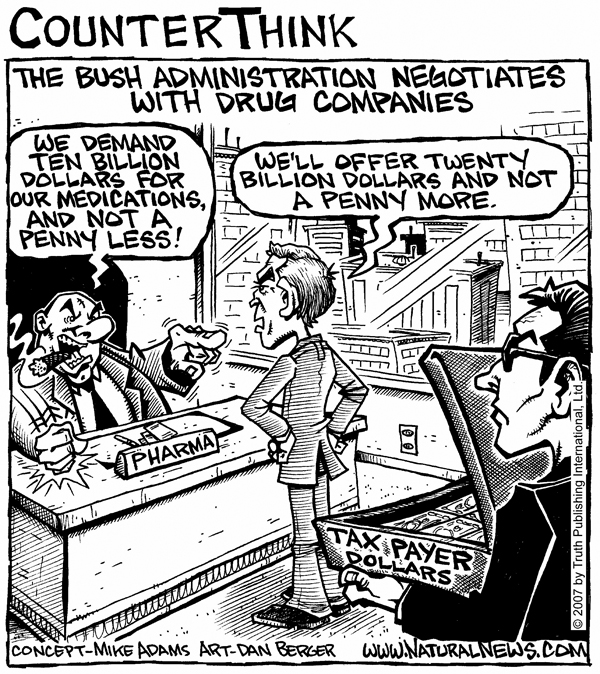
Meanwhile, the American people are the most diseased people in the world among advanced nations. We spend more on health care than anyone, we pay the highest prices for medications, and we're constantly told that we have the best medical technology in the world. But if our health care system is really so good, why do 50 million Americans have no health insurance? Why are hospitals literally dumping uninsured patients on the street, abandoning the sick to protect profits while our politicians actually negotiate on behalf of Big Pharma to make sure Americans keep paying the highest prices in the world for medications? (Click here to see our CounterThink cartoon on President Bush's price negotiations with drug companies.)
What's wrong with America's health care system?
SiCKO is a must-see documentary
SiCKO creator Michael Moore answers that all-important question in his best documentary yet. Forget whatever criticism you may have heard about SiCKO -- this is a Michael Moore masterpiece: A courageous, impactful and outrageous documentary that exposes the arrogance of modern medicine and the utter failure of America's corporate-controlled sick care system to provide decent health care to the people. Watching this movie will leave you either steaming mad or shedding tears (or both). It reveals the deep-rooted corruption in America's health care system and explains why the whole system was actually designed to deny health care to the American people.I've been ranting about America's health care failures for years, and as I've consistently stated to the amazement of some, the health care corporations actually have a plan to keep people sick. There's no money in preventing disease, especially in the cancer industry. Click here to read my recent report on the American Cancer Society's refusal to help prevent 77% of all cancers using affordable, scientifically-proven vitamin D supplements.
In SiCKO, what Moore does very effectively is tells this story to a mass audience, weaving together the emotionally-charged stories of American citizens who lost husbands, daughters and other family members to preventable disease, all thanks to intentional, well-planned payment denials by health insurance companies. In one segment in the film, he features archival footage of former President Nixon, who strongly approves of a new 1970's health care concept called the "HMO" where the more patients are denied health care services, the more money the hospitals and health insurance companies rake in!
In contrast to all this, Moore shows us the universal health care systems in countries like Canada, the UK, France and even Cuba... all countries where health care is free to everyone. It's called universal health care (or "socialized medicine"), and it's a system followed by nearly every modern nation in the world... and even some not-so-modern nations. Only America practices medicine in the Dark Ages, tied to a hopelessly corrupt system of financial exploitation and monopoly price controls, where Big Pharma gets richer, the FDA gets more powerful, and the American people get the shaft.
See my CounterThink cartoon, The Disease Economy, for a visual representation of this mess we're in, or read my book Natural Health Solutions and the Conspiracy to Keep You From Knowing About Them to see just how evil and corrupt our modern health care system really is.
Why Moore is being so vicious attacked
Moore, as usual, is being targeted by all sorts of critics who would like nothing better than to see this guy disappear and stop rocking the Good 'ol Boys boat that seems to be floating just fine in America (as long as you're part of the wealthy elite, anyway). For starters, U.S. government officials are investigating Moore for violating travel restrictions to Cuba. And why? Because Moore gathered a dozen Americans who were denied health care in the U.S. and brought them to Cuba where they received free, quality health care in a modern Cuban hospital.The message is hard to miss: Cuba takes better care of its citizens than America does. In fact, Cuba is willing to take care of a few American citizens that America abandoned! That kind of "in-yo-face" embarrassment to U.S. officials isn't appreciated much in police-state America these days, where practically anyone who dares question the wisdom of the government is branded a terrorist. Moore is clearly being targeted not merely because he took some 9/11 heroes to Cuba and got them health care, but because he dared to make it all public. Humiliating the King is a quick way to find your head on a chopping block. Just ask all the scientists who publicly disagree with the Bush Administration's hopelessly politicized view on climate change...
Other critics of Moore are either the greedy, corrupt corporations impacted by his film (drug companies, health insurance providers, hospitals and so on) or juvenile stay-at-home back-seat Internet critics who don't like Moore for the simple fact that he dares to stand up and say "The Emperor Has No Clothes!" Nearly all the criticism leveled against Moore is without substance. People attack Moore personally, but they won't dare debate what he's presenting in the movie. Why? Because Michael Moore is right. America's health care system is an embarrassment to the nation, and to the world. It's so bad that most informed world citizens wouldn't be caught dead in this country, unless of course they actually visit America and have an accident that lands them in the U.S. health care system.
Personally, I opted out of the American health care system long ago. I'm a holistic nutritionist, and I exercise, eat right, get lots of sunshine and gorge on superfoods and raw berries. I have no need for a doctor, or a pharmaceutical, or a health insurance policy. I don't get annual physical exams, and I have zero risk of cancer, heart disease, diabetes or other common health conditions. (I posted my health statistics at www.HealthRanger.org if you want to see my blood workup.)
At the same time, I realize that not everybody is in such a fortunate health position. Most people simply don't take care of their own health, and while I could argue for days about the need for more patient responsibility alongside corporate responsibility, the fact is that relentless advertising from drug companies and food manufacturers has bred a mindset of disease, junk food consumption, pharmaceutical dependence and patient victimization. We have a health crisis in this country, and it's going to take genuinely radical reforms to turn this around and save America from a financial wipeout exacerbated by runaway health care spending.
What's missing from SiCKO
The material that's in SiCKO is hard-hitting, and it accomplishes what it sets out to do. But there's something missing from the film: A serious discussion about how a nation can prevent disease using nutrition, medicinal herbs, sunshine, clean water, avoidance of toxic chemicals, smart dietary choices, banning the advertising of junk foods and pharmaceuticals, and so on. Of course, that's not really what SiCKO set out to do, and this topic would require another film all by itself, but personally I wouldn't have minded a stronger nod towards solving our nation's health care problems through genuine prevention (rather than the current policy which is basically centered around waiting for everybody to get sick and then treating their symptoms while ignoring the true causes of their disease).Of course, it might be tricky for Moore to argue for disease prevention given that he is obviously not the poster boy for ideal physical health. But he never claims to be. So the critics who attack Moore's own personal health are missing the whole point of the film. Moore is simply pointing out what's wrong with America's health care system, and he does so brilliantly and convincingly, regardless of his own personal health status. And besides, if you want to argue about the health of "experts," just walk into any hospital and take a look at the health of all the people who work there. Many aren't any healthier than Moore, and they work in the industry! The average lifespan of a U.S. doctor is less than a Cuban peasant. That's not a joke.
Regardless of Moore's present physical fitness challenges, he's obviously operating with a great degree of healthy skepticism about the way the U.S. operates today. Moore is an independent thinker who simply refuses to follow the crowd, and with this film, he's doing the job that the American people should have been doing all along -- questioning the sanity of our health care system. But sadly, the truth is that most Americans are sheeple who just follow the herd and do what they're told. A recent poll revealed that nearly 45% of Americans still trust the FDA! That's astounding, given that I've solidly established the Food and Drug Administration is far more dangerous to the health and safety of the American people than all the terrorists in the world. To learn more, read my article The lawlessness of the FDA, Big Pharma immunity, and crimes against humanity.
How will SiCKO play?
I think SiCKO's timing is perfect, and I think the movie will be a significant factor in the upcoming 2008 elections. Those politicians who run on a platform of radical health care reforms are likely to pick up a lot more support than those unwise enough to try to defend the current system.This is a tough call for Republicans, since most Republicans support Big Pharma and the corporate control of modern medicine, usually at the expense of the people. Democrats, though, are also on Big Pharma's payroll, as was obvious with the recent voting record on the FDA Revitilization Act co-sponsored by Sen. Edward Kennedy. The truth is, Big Pharma owns virtually all the politicians in Washington (except Rep. Ron Paul, of course).
The movie will definitely get America talking about serious health care reforms. But as I've pointed out in a previous article, Where's the Health In Health Care Reform?, almost nobody is considering proposals that would genuinely solve the health care problem in America today. You can't "treat" your way out of a nation that has become so over-drugged, over-fed and over-diseased that even the little children are now being put on speed (also called "Ritalin"). Nearly 50 percent of American adults are now taking pharmaceuticals, most of which are utterly unnecessary from a medical point of view. Drug advertising has taken over the media, the FDA has suppressed natural alternatives, and the American Medical Association continues to peddle such health nonsense that it's amazing the AMA hasn't yet been invited to join the Smithsonian's Museum of Outdated American History.
The American Cancer Society, in my opinion, is a supremely corrupt, big-business front group that actually takes steps to ensure more cases of future cancer by "preventing prevention," the American Diabetes Association takes money from candy and soda manufacturers, and the American Psychiatric Association is so steeped in Big Pharma money that they've practically become inseparable. (Click here to see my CounterThink cartoon on this topic.)
The future of America looks dim
Clearly, something has to change in this country if we're going to survive as a nation. Under the current system of massive debt spending, widespread political corruption, war mongering and health care failures, the United States of America will simply not survive another generation. No nation that abandons the health of its people can expect to have a future. As Moore points out, however, there is a chance to save America, but only if we make significant changes starting now.Truly radical changes must be put into place. I've offered many suggestions in a popular article, The health care reform legislation that Congress should pass, but won't. Lawmakers, you see, have no interest in actually saving America from financial demise. They're only concerned about the next election, and raising campaign reelection funds means kow-towing to the interests of the powerful corporations that really run Washington.
Personally, I don't see that meaningful reform is possible under the current system of politics in America. The Big Business sick care industry has a stranglehold on the American political system, and the whole ugly thing will mostly likely have to collapse and be rebooted before we'll see significant change.
And make no mistake: that's what's coming. I predict America will not survive its health care crisis. It won't be the first empire to crumble from arrogance and corruption. In fact, it will join a long (and growing) list of civilizations that have risen and fallen, securing its place in the pages of history as yet another imperialist nation that thought it could rule the world while abandoning the needs of its own people.
The bottom line on SiCKO
It's a must-see documentary. It's surprisingly even-handed and well grounded, never resorting to unsubstantiated claims merely to shock the audience. In fact, as a person who has been writing about America's health care problems for four years, I didn't detect a single false statement in the film. It's all true, and it's pretty damn scary. Go see it. It opens on June 29th.And if, like one person featured in the film, I ever have to choose between reconnective surgery for my middle finger at $60,000 vs. my ring finger at $12,000, I'll choose to have my middle finger sewn on first just so I can visually demonstrate to U.S. Senators precisely how I feel about America's health care system today.
Hillary Clinton's Universal Health Care Plan: Buy Health Insurance or Else!
NaturalNews) As candidates for U.S. President continue to battle for their respective parties' nominations, details are beginning to emerge about their (disastrous) health care plans. The New York Times is now reporting that Hillary Clinton's universal health care plan will be accomplished through "enforcement measures" that may include garnishing the wages of people who choose not to buy health insurance. What this comes down to, of course, is yet another form of medical tyranny where citizens are forced by threat of financial penalty to participate in conventional medicine's health insurance scheme that pushes drugs, surgeries, chemotherapy and other harmful treatments while disallowing converage of naturopathic health therapies that really work (like nutritional therapy).
Hillary Clinton's universal health care plan, then, is nothing more than a system for threatening all Americans to buy health insurance, and then financially punishing them if they don't. For people like myself who choose not to participate in America's drugs-and-surgery health care scam, Clinton's proposal would equate to yet another form of government-inspired financial tyranny that further erodes personal freedoms in a country that claims to be "free."
Clinton claims that people who choose to not buy health insurance are a "burden" on those who do, as if our opting out of that whole system of sickness and disease is somehow costing the nation extra money. It isn't, of course: People who choose to prevent disease and stay healthy while refusing to buy health insurance are actually saving money for the nation and, in fact, adding productivity to our economy. It's the sick people who eat junk foods and take pharmaceuticals that are the real financial burdens on society, and those are precisely the people who typically stay enrolled in the drugs-and-surgery system of health insurance.
With Clinton at the helm, the government will now exercise yet more control over your paycheck, stealing yet more of your money by confiscating a portion of your wages and turning them over to corrupt health insurance companies that do absolutely nothing to encourage real health.
It would be yet another government scam to further enrich the corporations that make money by keeping people sick and diseased, and under a Clinton regime, the enforcement of this ridiculous measure would push the United States of America ever closer to a nation of pharmaceutical enslavement where virtually all options for alternative medicine are eliminated. Consumers must be required to participate in conventional (pharmaceutical) medicine, didn't you know? And the government, of course, knows what's best for your health.
The Clinton-led invasion of your paycheck
If this wasn't a serious plan put forth by Hillary Clinton, the whole thing would be laughable. It won't be so funny, however, if Clinton becomes President and starts dictating such policies to the American people. If you thought George W. Bush was insane with his invasions of Afghanistan and Iraq, just wait until Hillary Clinton starts invading your personal lives and weekly paycheck. By the time you pay off the IRS, the mandatory health insurance scam, your home mortgage and local property taxes, you have just enough left to pay for prescription medications and junk food. And that, of course, is right where the folks in charge want you: Broke, diseased and powerless.Clinton believes that the best way for society to solve problems is to force the people to follow government policy, and take away their paychecks if they don't. It's a form of financial tyranny, and the fact that she's announcing all this even before winning the election indicates just how little respect Clinton has for individual liberty and real freedom.
Fortunatately, Obama is giving Clinton some stiff competition on the Democratic side, and if we're lucky, we won't have to face the possibility of seeing Clinton elected. I'll take Obama over Clinton any day. And yet, the only real choice for people who desire genuine freedom is, of course, Ron Paul. As President, Paul would get the government out of our lives (and our paychecks), returning freedom and responsibility to the American people. This fact -- that people might actually have to think for themselves -- scares the bejeezus out of at least half the U.S. population, and that's why they're continuing to blindly support status quo candidates who openly stand for more war (McCain and Huckabee) or more Big Brother enslavement (Clinton).
In terms of health care, the NaturalNews ranking of candidates to support, is:
1. Ron Paul: A champion of health freedom. Would curtail FDA powers and restore health freedom to America.
2. Dennis Kucinich: No longer a serious candidate, but he's a vegan, and he believes in preventive medicine and protecting the environment.
3. Barack Obama: Believes in universal health care coverage, and he's an outsider who doesn't have as many dirty corporate ties that keep the Clinton machine running. Obama supports animal rights (he says), and might be willing to rock the health care boat if elected president. Obama holds promise, but we'll have to wait and see whether he's willing to stand up to Big Pharma.
Beyond these three candidates, there is nobody else that has a position on health care that NaturalNews can support. Even Obama's health care plan remains to be seen -- it might end up being just as bad as Clinton's. If there's one thing we've all learned about politicians, it's that they will say anything to get elected. Just because they promise something doesn't mean they'll pursue it once they get into office.
The truth about health care that politicians won't dare admit
Want to know the real truth about health care in this nation? I tell it like it is:1. Health care spending will bankrupt this nation. 84% of the U.S. government's budget is now spent on three things: Disease, debt and war. The national debt is now over $9 trillion (see clock). The U.S. dollar is losing value. This nation will not survive its own crushing debt. Expect hyperinflation of an increasingly-worthless currency.
2. No elected president will propose a health care system that actually makes people healthy. (The disease corporations wouldn't stand for it.) There is simply no profit to be found in teaching the public how to avoid disease. Eliminating disease and the sick care industry would put millions out of work and implode the economy.
3. All this talk about "who pays" for health care is a joke. Unless you start talking about ways to keep people healthy and ban the advertising of pharmaceuticals, junk foods and sodas, we will remain stuck in a system of disease management where nobody wins!
4. The Fall of Western Medicine is fast approaching. When the United States collapses under a worthless dollar and a desperate hyperinflation bailout attempt, much of what the U.S. espouses will also be shunned by nations around the world, including its deadly system of pharmaceutical-based medicine. The collapse of the U.S. money supply will inevitably result in the collapse of Big Pharma's profitability, since it is nothing more than debt spending (at all levels: Personal, municipal and nation) that currently supports Big Pharma's monopoly prices for pharmaceuticals.
Haven't heard these statements from mainstream politicians? Of course you haven't. Expecting popular politicians to tell the truth is like expecting pigs to fly. Only Ron Paul dares to talk about reality, and for his efforts he's been marginalized by the MSM.
Let's face it: The American voters love to be lied to. In fact, they can't accept a President that tells them the truth. What they really want, when it comes down to it, is four more years of lies: The economy is great, your future is secure, we're winning the War on Terror, the War on Drugs, the War on Cancer and every other lie you can imagine. Oh yes, and don't forget: Deposit your life savings in dollars, please, and don't question anything we tell you, or we'll label you a terrorist and have you arrested.
Of course, despite all this talk about Clinton's disastrous health insurance proposal, let me be clear that electing a Republican for President will likely only continue Big Pharma's powerful influence over Washington. The drug companies have been very, very cozy with the Bush Administration, and there is a fundamental lack of understanding about nutrition, Mother Nature and natural medicine in the Republican party. So in terms of health care, I don't support any of the Republican candidates either (other than Ron Paul, due to his "freedom" platform and the fact that he's really a Libertarian).
The way this election is shaping up right now, it looks like we're going to be given a choice between bad and worse. Sound familiar?
Heard of preventive care? Get ready for one
Preventive care - That's the new mantra of today. Gone are the days when you only visited a neighbourhood doctor while you were absolutely unwell and your usual die hard habits of popping in pills never helped much. With the new age science of preventive healthcare bringing sweeping changes in the healthcare industry get set to see a total transformation in healthcare.
More professionalism:
The concept of managed care is coming up in a big way, which will provide a comprehensive range of services from preventive primary care to long-term care. And that's not all. Healthcare is getting more professional and commercial too. Perhaps its the rising consumerism, growing need for better healthcare facilities or the discerning middle class getting more demanding, it's the dawn of a new era for the healthcare industry.
For economically weaker sections:
With the recent spate of insurers coming in, healthcare seems to have come of age. While hospitals such as Apollo did dole out healthcare packages, these were by and large limited to the higher echelons of society, the privileged few. Today times have changed and quality healthcare will soon be made accessible to the economically weaker sections too at an affordable price.
Healthcare companies:
Considering the potential the healthcare industry holds, a number of companies are busy working out strategies. Also a new breed of third party administrators (TPAs), will play their role and help administer these strategies to reach out to the consumer. Max India, Fortis Healthcare, Paramount Healthcare, BUPA Piramal, a joint venture between the Piramal group and the UK-based healthcare major BUPA are few which have ventured into this arena.
Speciality hospitals:
Max India is setting up a network of about 35 to 40 primary care clinics, four diagnostic centres (with ambulatory surgery facilities), two medium-sized hospitals, and a large state-of-the-art tertiary care hospital by 2005.
While, Apollo plans to set up speciality hospitals here as also abroad and Apollo Lifestyle Clinics too, of which 200 will begin their operations by end of 2002 some companies believe in going via the primary route as they feel this could help them tap the market better since patients approach the nearby primary clinic first.
Third party administrators:
The Insurance Regulatory Development Authority (IRDA) is yet to come out with the final guidelines on third party administrators. While the draft regulations are already out a number of changes are required in the norms set, in order to encourage the newcomers set up shop here. Also the sale of healthcare products has not been permitted by the regulator which has proved to be a major setback to them considering the large amount of investment that has already been made.
But things are expected to change for the better bringing in better services, products and facilities for one and all that will change the face of the healthcare industry that it was.
New age healthcare gets going
The Insurance Regulatory Development Authority (IRDA) has now changed the draft regulations for third party administrators to permit sale of healthcare products. This has come as a welcome relief for the local as also overseas managed healthcare companies to go ahead with their almost -worked- out strategies and investment decisions. Overseas companies: Also considering the fact that the healthcare industry is only beginning to exploit the vast potential and also since there exists no cap on foreign direct investments, a number of companies for instance Aetna, Blue Shield, Cigna, Sloan Lake, Care Inc, Blue Cross etc are planning joint ventures with Indian outfits to set up shop. Economical covers: The 7000 crore healthcare industry has only begun to see activity. So far thanks to the lackadaisical attitude of the government run hospitals, the unorganised system of administering medicare quality of service left much to be desired. Henceforth policyholders will be provided with better service and economical covers that will take care of the whole aspect of healthcare inclusive of primary, secondary and tertiary care, to be hopefully provided under one roof saving the policyholder the trouble of running from pillar to post for treatments. Several services: Policyholders can in the near future, look forward to a cashless hospitalisation system; a 24-hours hotline service in case of an emergency, claims, critical care services including admission in ICU; doctor on call for visiting corporates and institutions to provide consultancy; managed care programmes in preventive care, child care and old-age etc among others. Expanding existing network: Another advantage of such a changed scenario will be the low cost, coupled with quality covers that will encompass even the lower sections of society. Ican Medicare, Paramount Healthcare, Sedgwick Parekh etc among others will now work on expanding their network. Already Ican has drawn up plans to set up six more offices and a few others will soon join the fray to ensure a better treat for the policyholder.
Friday, February 15, 2008
A Step-by-Step Guide in Auto Insurance
It's very important that you're able to acquire an auto insurance. You need it since it's not all the time you're going to have funds for your car, especially when it gets damaged due to collision. But do you know what to look for and how to get one?
1. Set your budget. Before you start choosing your car insurance, know first how much you're willing to spend for the premium. It will never be the right amount, as there are still a lot of things that you have to consider, but at least you will have an idea how much money you're going to set aside for it. It's also ideal if you do have a budget so the insurance company will be able to suggest you a package that you can afford. Just so you can easily make your estimate, you can try doing some research on the current average premiums for car insurance.
2. Know what type of coverage you need. Your premium will basically depend on your coverage. Hence, even before you talk to any insurance agent, know first what you truly want. Keep in mind that some brokers will eventually entice you to buy an insurance coverage that you actually don't need. It only means that you're simply wasting your money. If you aren't sure what type of coverage to select, you can refer to your state. There are some places that mandate the insurance coverage every driver should get. You can also add liability coverage in your list. You need this just in case you have accidentally bumped into someone else's car or caused damage because of your own doing. If you like to lower down your expenses, you can also shop for an auto insurance coverage that includes other kinds of insurance, such as life or accidental.
3. Start looking for an insurance company. When you already have an insurance coverage in mind, you need to obtain a quote. But before you can get one, you have to look for an insurance company first. It's definitely a great idea if you rely on the recommendations of your friends and family members. Surely, they wouldn't suggest anyone that won't be able to provide excellent service to you. You can also look for one over the Internet, but it's better if it has an office somewhere near your area. There's one thing you need to remember: don't just simply go for one that has very low premium or an excellent package. More than anything else, make sure that it has superb customer service support, one that you can call 24 hours a day, 7 days a week. You simply just don't know when you will need to use your car insurance.
4. Always start the hunting with a call. There are some people who would directly meet their agent face to face. Though this could be good as you can directly obtain information about your desired car insurance policy, this isn't advisable - at least when you're still trying to shop for a company. Just making a call and inquiring about their products will not make you feel awkward if you decide not to deal with them.
5. Know the policies of the company. There are numerous car owners who make the mistake of only understanding what they would get and forgetting about their obligations to the company. If you don't like to be surprised with charges you don't know about or why you can't avail your insurance in certain situations, know their policies first. This should also be accomplished even before you purchase a policy.
The Right Way to File a Claim in Your Auto Insurance
If you have got yourself an auto insurance, then you're entitled to get a claim. The problem is there are numerous car owners who are able to do so simply because they don't know how to file one. In the end, they're not able to enjoy the premiums they constantly pay to their insurance company. A claim is something you need to obtain when your vehicle meets an accident or when you're injured because of a collision. It will basically cover the cost, partial or full, for the repair or your hospitalization.
To ensure that you can fully maximize your premium and obtain your claim the soonest time possible, here are some techniques:
1. Make a report of the incident right away. Don't wait until the next day to file your incident report or at least list down what happened. The later you will make one the higher the chances that you're going to forget it are. You need all these information once you're going to file your claim. If you cannot create your own report for one reason or the other, at least have someone to do it for you, with your assistance. Besides, a more detailed report will make it very easier for the insurance company to decide how much claim you will be entitled with.
2. Notify the police. Notifying the police will further strengthen your case and will improve your chances of being granted with your claim. There are many instances that you should seek professional help immediately or inform the police. First, you must notify them if your vehicle got stolen or someone has vandalized something. You must also provide them a report if your car gets damaged because of collision or a person has purposely did it. It's also advisable to make a report if you have been injured because of a vehicular accident. All these can be filed together with your own incident report. It will establish the credibility of your story.
3. Call your insurance company immediately. This is the part when you will be grateful of your insurance company's 24-hour hotline. If you get yourself in any form of trouble, with undue damage on your vehicle, you have to file a report right away so the insurance company will be able to act upon it the soonest time possible. It will also remove any doubt that could play up in their minds. Remember, not all policy holders are as honest as you. Some of them will simply create stories so they'll be able to make a claim. Nevertheless, don't end the notification with a call. The next day, submit an intent-to-claim letter. If it's possible, state that you have already placed a call and the name of the customer service representative that you have talked to.
4. Know what to do next. Companies have their own way of processing claims, so it's recommended that you obtain first-hand information on the right steps to do it. First, know if there are still some requirements you need to accomplish, your rights and obligations to your claim, and how soon before you will be able to get your claim.
The Trouble With Vehicle Insurance Policies
Cars, Bike, trucks, lorries, vans and motorcycles - all of which require insurance to safeguard you from any unpredictable events and covering expenses. Without them, you may have to pay up a hefty fine. Fortunately, vehicle insurance is improving and cheaper insurance are always readily available offering more services.
Even young people can be offered cheap scooter insurance, as more young people are opting towards riding a moped/scooter for travelling, before learning to drive a car. The downside of it all is finding the right one for you. Insurance adverts have become very clever, more gimmicky and they all appear to sound the same offering the same things. Very different from the original purposes of insurance, when insurance meant protecting and preventing from crises.
Brief History of Insurance
Even looking for simple cheap scooter insurance requires in depth research and understanding of the users requirements before they apply for the insurance policy. Insurance is something that has been in progress for many years. Human society function on two types of economies, the first being financial (market, money and financial instrument) and the second being non-financial or non-money economy (without money, market etc).
The second economical principle is an ancient practise, whereby people help each other in times of crisis and are guaranteed help if they need it should a crisis occur for them. Money economy is the more common modern principle that we live by. Financial insurance became more of a common practise during the - mid 17th and 18th century, particularly focussing on building insurance against fire hazards.
The insurance policies were sparked after the devastations left by the Great Fire of London in 1666. Nicholas Barbon established the first Fire Insurance Company in England, for the sole purpose of insuring buildings from fire. In 1680 his office formed the first London fire Brigade. Benjamin Franklin later founded the first fire insurance company that contributed towards fire prevention with the exception of contributing towards buildings that had a higher risk of fire e.g. wooden houses.
Modern Insurance Practises
Today vehicle insurances are the most commonly used form of insurance. For young people, the most common type of transport they begin with for travelling independence are scooters. This is a great way for young people to introduce themselves to vehicle insurance and gain responsibility in maintaining their vehicle. Though when looking for cheap scooter insurance, one should know that the policies are almost the same as a normal motorcycle insurance policy, excluding insurance on added/customized parts to the scooter/moped and vary in prices.
Car insurance are widely advertised in the UK alone. Big branded insurance companies offer courtesy cars, whilst the previous car is in repair. Other insurance policies offer coverage for medical expenses, third party cover, legal liabilities, and damage to the vehicle, breakdown coverage and even car towing cover. Certain parts of America will not permit cars on the roads unless the drivers have applied for insurance. The best way to find the right insurance policy is to compare prices, terms and conditions, gain advice from experienced drivers or for first time drivers to join onto a third party insurance to reduce costs.
Insurance policies are far more complicated than what they were when they were first introduced. Many vehicle insurance companies require details of the make of your vehicle, your age, past driving records, age of your vehicle etc. Not to mention premium charges, excess payments, legal costs etc. No matter how different insurance appears to be now, it still maintains the policy to cover costs, whilst staying strong in the mainframe of the financial economic sphere.
Buyers Guide For Personal Health Insurance
If you have ever been sick or injured, you know how important it is to have health coverage. But if you're confused about what kind is best for you, you're not alone.
If your employer offers you a choice of health plans, what should you know before making a decision? What types of health coverage are available? In addition to coverage for medical expenses, do you need some other kind of insurance? What if you are too ill to work? Or, if you are over 65,will Medicare pay for all your medical expenses?
These questions aren't necessarily easy to answer.
This booklet should help. It discusses the basic forms of health coverage and includes a checklist to help you compare plans. It answers some commonly asked questions and also includes thumbnail descriptions of other forms of health insurance, including hospital-surgical policies, specified disease policies, catastrophic coverage, hospital indemnity insurance, and disability, long-term care, and Medicare supplement insurance.
While we know that our guide can't answer all your questions, we think it will help you make the right decisions for yourself, your family, and even your business.
Making Sense of Health Insurance
The term health insurance refers to a wide variety of insurance policies. These range from policies that cover the costs of doctors and hospitals to those that meet a specific need, such as paying for long-term care. Even disability insurance - which replaces lost income if you can't work because of illness or accident - is considered health insurance, even though it's not specifically for medical expenses
But when people talk about health insurance, they usually mean the kind of insurance offered by employers to employees, the kind that covers medical bills, surgery, and hospital expenses. You may have heard this kind of health insurance referred to as comprehensive or major medical policies, alluding to the broad protection they offer. But the fact is, neither of these terms is particularly helpful to the consumer.
Today, when people talk about broad health care coverage, instead of using the term "major medical," they are more likely to refer to fee-for-service or managed care. These terms apply to different kinds of coverage or health plans. Moreover, you'll also hear about specific kinds of managed care plans: health maintenance organizations or HMOs, preferred provider organizations or PPOs, and point-of-service or POS plans.
While fee-for-service and managed care plans differ in important ways, in some ways they are similar. Both cover an array of medical, surgical, and hospital expenses. Most offer some coverage for prescription drugs, and some include coverage for dentists and other providers. But there are many important differences that will make one or the other form of coverage the right one for you.
The section below is designed to acquaint you with the basics of fee-for-service and managed care plans. But remember: The detailed differences between one plan and another can only be understood by careful reading of the materials provided by insurers, your employee benefits specialist, or your agent or broker.
Fee-for-Service
This type of coverage generally assumes that the medical provider (usually a doctor or hospital) will be paid a fee for each service rendered to the patient - you or a family member covered under your policy. With fee-for-service insurance, you go to the doctor of your choice and you or your doctor or hospital submits a claim to your insurance company for reimbursement. You will only receive reimbursement for "covered" medical expenses, the ones listed in your benefits summary.
When a service is covered under your policy, you can expect to be reimbursed for some, but generally not all, of the cost. How much you will receive depends on the provisions of the policy on coinsurance and deductibles. Here's how it works:
The portion of the covered medical expenses you pay is called "coinsurance." Although there are variations, fee-for-service policies often reimburse doctor bills at 80 percent of the "reasonable and customary charge." (This is the prevailing cost of a medical service in a given geographic area.) You pay the other 20 percent - your coinsurance. However, if a medical provider charges more than the reasonable and customary fee, you will have to pay the difference. For example, if the reasonable and customary fee for a medical service is $100, the insurer will pay $80. If your doctor charged $100, you will pay $20. But if the doctor charged $105, you will pay $25. Note that many fee-for-service plans pay hospital expenses in full; some reimburse at the 80/20 level as described above.
Deductibles are the amount of the covered expenses you must pay each year before the insurer starts to reimburse you. These might range from$100 to $300 per year per individual, or $500 or more per family. Generally, the higher the deductible, the lower the premiums, which are the monthly, quarterly, or annual payments for the insurance. Policies typically have an out-of-pocket maximum. This means that once your expenses reach a certain amount in a given calendar year, the reasonable and customary fee for covered benefits will be paid in full by the insurer. (If your doctor bills you more than the reasonable and customary charge, you may still have to pay a portion of the bill.) Note that Medicare limits how much a physician may charge you above the usual amount. There also may be lifetime limits on benefits paid under the policy. Most experts recommend that you look for a policy whose lifetime limit is at least $1 million. Anything less may prove to be inadequate.
Managed-Care
The three major types of managed care plans are health maintenance organizations (HMOs), preferred provider organizations (PPOs), and point-of-service (POS) plans.
Managedcare plans generally provide comprehensive health services to their members, and offer financial incentives for patients to use the providers who belong to the plan. In managed care plans, instead of paying separately for each service that you receive, your coverage is paid in advance. This is called prepaid care.
An example, you may decide to join a local HMO where you pay a monthly or quarterly premium. That premium is the same whether you use the plan's services or not. The plan may charge a copayment for certain services - for example, $10 for an office visit, or $5 for every prescription. So, if you join this HMO, you may find that you have few out-of-pocket expenses for medical care - as long as you use doctors or hospitals that participate in or are part of the HMO. Your share may be only the small copayments; generally, you will not have deductibles or coinsurance.
The most interesting things about HMOs is that they deliver care directly to patients. Patients sometimes go to a medical facility to see the nurses and doctors or to a specific doctor's office. Another common model is a network of individual practitioners. In these individual practice associations (IPAs), you will get your care in a physician's office.
If you belong to an HMO, typically you must receive your medical care through the plan. Generally, you will select a primary care physician who coordinates your care. Primary care physicians may be family practice doctors, internists, pediatricians, or other types of doctors. The primary care physician is responsible for referring you to specialists when needed. While most of these specialists will be "participating providers" in the HMO, there are circumstances in which patients enrolled in an HMO may be referred to providers outside the HMO network and still receive coverage.
PPOs and POS plans are categorized as managed care plans. (Indeed, many people call POS plans "an HMO with a point-of-service option.") From the consumer's point of view, these plans combine features of fee-for-service and HMOs. They offer more flexibility than HMOs, but premiums are likely to be somewhat higher.
With a PPO or a POS plan, unlike most HMOs, you will get some reimbursement if you receive a covered service from a provider who is not in the plan. Of course, choosing a provider outside the plan's network will cost you more than choosing a provider in the network. These plans will act like fee-for-service plans and charge you coinsurance when you go outside the network.
What is the difference between a PPO and a POS plan? A POS plan has primary care physicians who coordinate patient care; and in most cases, PPO plans do not. But there are exceptions!
HMOs and PPOs have contracts with doctors, hospitals, and other providers. They have negotiated certain fees with these providers - and, as long as you get your care from these providers, they should not ask you for additional payment. (Of course, if your plan requires a copayment at the time you receive care, you will have to pay that.)
Always look carefully at the description of the plans you are considering for the conditions of payment. Check with your employer, your benefits manager, or your state department of insurance to find out about laws that may regulate who is responsible for payment.
Self-insured Plans
Your employer may have set up a financial arrangement that helps cover employees' health care expenses. Sometimes employers do this and have the "health plan" administered by an insurance company; but sometimes there is no outside administrator. With self-insured health plans, certain federal laws may apply. Thus, if you have problems with a plan that isn't state regulated, it's probably a good idea to talk to an attorney who specializes in health law.
Appropriate Care
HMOs, PPOs, and fee-for-service plans often share certain features, including pre authorization, utilization review, and discharge planning.
For example, you may be asked to get authorization from your plan or insurer before admission to a hospital for certain types of surgery. Utilization review is the process by which a plan determines whether a specific medical or surgical service is appropriate and/or medically necessary. Discharge planning is an approach that facilitates the transfer of a patient to amore cost-effective facility if the patient no longer needs to stay in the hospital. For example, if, following surgery, you no longer need hospitalization but cannot be cared for at home, you may be transferred to a skilled nursing facility.
Almost all fee-for-service plans apply managed care techniques to contain costs and guarantee appropriate care; and an increasing number of managed care plans contain fee-for-service elements. While the distinctions among plans are growing increasingly blurred, the number of options available to consumers increases every day.
How Do I Get Health Coverage?
Health insurance is generally available through groups and to individuals. Premiums - the regular fees that you pay for health insurance coverage - are generally lower for group coverage. When you receive group insurance at work, the premium usually is paid through your employer.
Group insurance is typically offered through employers, although unions, professional associations, and other organizations also offer it. As an employee benefit, group health insurance has many advantages. Much - although not all - of the cost may be borne by the employer. Premium costs are frequently lower because economies of scale in large groups make administration less expensive. With group insurance, if you enroll when you first become eligible for coverage, you generally will not be asked for evidence that you are insurable. (Enrollment usually occurs when you first take a job, and/or during a specified period each year, which is called open enrollment.) Some employers offer employees a choice of fee-for-service and managed care plans. In addition, some group plans offer dental insurance as well as medical.
Individual insurance is a good option if you work for a small company that does not offer health insurance or if you are self-employed. Buying individual insurance allows you to tailor a plan to fit your needs from the insurance company of your choice. It requires careful shopping, because coverage and costs vary from company to company. In evaluating policies, consider what medical services are covered, what benefits are paid, and how much you must pay in deductibles and coinsurance. You may keep premiums down by accepting a higher deductible.
Pre-existing Conditions
Many people worry about coverage for preexisting conditions, especially when they change jobs. The Health Insurance Portability and Accountability Act (HIPAA) helps assure continued health insurance coverage for employees and their dependents. Starting July 1, 1997, insurers could impose only one 12-month waiting period for any preexisting condition treated or diagnosed in the previous six months. Your prior health insurance coverage will be credited toward the preexisting condition exclusion period as long as you have maintained continuous coverage without a break of more than 62 days. Pregnancy is not considered a preexisting condition, and newborns and adopted children who are covered within 30 days are not subject to the 12-monthwaiting period.
If you have had group health coverage for two years, and you switch jobs and go to another plan, that new health plan cannot impose another preexisting condition exclusion period. If, for example, you have had prior coverage of only eight months, you may be subject to a four-month, preexisting condition exclusion period when you switch jobs. If you've never been covered by an employer's group plan, and you get a job that offers such coverage, you may be subject to a 12-month, preexisting condition waiting period.
Federal law also makes it easier for you to get individual insurance under certain situations, including if you have left a job where you had group health insurance, or had another plan for more than 18 months without a break of more than 62 days.
If you have not been covered under a group plan and have found it difficult to get insurance on your own, check with your state insurance department to see if your state has a risk pool. Similar to risk pools for automobile insurance, these can provide health insurance for people who cannot get it elsewhere.
What Is Not Covered?
While HMO benefits are generally more comprehensive than those of traditional fee-for-service plans, no health plan will cover every medical expense.
Very few plans cover eyeglasses and hearing aids because these are considered budgetable expenses. Very few cover elective cosmetic surgery, except to correct damage caused by a covered accidental injury. Some fee-for-service plans do not cover checkups. Procedures that are considered experimental may not be covered either. And some plans cover complications arising from pregnancy, but do not cover normal pregnancy or childbirth.
Health insurance policies frequently exclude coverage for preexisting conditions, but, as explained, federal law now limits exclusions based on such conditions.
You should also remember that insurers will not pay duplicate benefits. You and your spouse may each be covered under a health insurance plan at work but, under what is called a "coordination of benefits" provision, the total you can receive under both plans for a covered medical expense cannot exceed 100 percent of the allowable cost. Also note that if neither of your plans covers 100 percent of your expenses, you will only be covered for the percentage of coverage (for example, 80 percent) that your primary plan covers. This provision benefits everyone in the long run because it helps to keep costs down.
A Final Word
If you get health care coverage at work, or through a trade or professional association or a union, you are almost certainly enrolled under a group contract. Generally, the contract is between the group and the insurer, and your employer has done comparison shopping before offering the plan to the employees. Nevertheless, while some employers only offer one plan, some offer more than one. Compare plans carefully!
If you are buying individual insurance, or any form of insurance that you purchase directly, read and compare the policies you are considering before you buy one, and make sure you understand all of the provisions. Marketing or sales literature is no substitute for the actual policy. Read the policy itself before you buy.
Ask for a summary of each policy's benefits or an outline of coverage. Good agents and good insurance companies want you to know what you are buying. Don't be afraid to ask your benefits manager or insurance agent to explain anything that is unclear.
It is also a good idea to ask for the insurance company's rating. The A.M. Best Company, Standard & Poor's Corporation, and Moody's all rate insurance companies after analyzing their financial records. These publications that list ratings usually can be found in the business section of libraries.
And bear in mind: In some cases, even after you buy a policy, if you find that it doesn't meet your needs, you may have 30 days to return the policy and get your money back. This is called the "free look."